
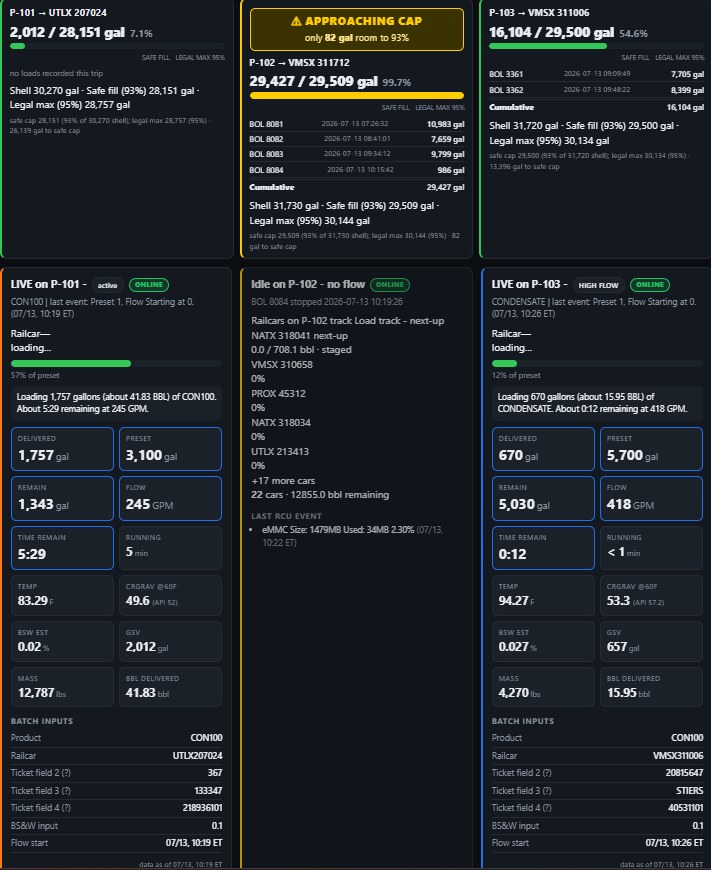
What an AI-operated terminal looks like
Most terminal operators still run on clipboards and month-end spreadsheets. The car is either loading or it isn't; the numbers get reconciled when someone gets around to it; problems surface after the customer calls. Timiron runs on a proprietary operations layer built in-house — an AI-native software stack deployed at our flagship terminal and designed to travel to the next one. We do not sell software. We operate terminals better because of it.
What the layer does
Live terminal telemetry
Every pump, meter, camera, and network link on the terminal reports continuously into one operations picture. The morning briefing writes itself; the state of the terminal is known before the first truck pulls in — not reconstructed from clipboards and phone calls after the fact.
Per-railcar fill telemetry with overfill guards
Every active car carries a live fill level, updated continuously from the metering system. The operator sees current volume, safe-fill target, and remaining room in real time. Automated overfill guards calculate net quantity against the car's actual shell capacity and fire before the car reaches its limit — not after. When a load needs to split across two cars, the system flags it and guides the crew through the transfer before the problem reaches the customer.
Automated reconciliation
Every load becomes a confirmed digital record the moment the pump stops — captured at the rack, confirmed by the loader, reviewed by a manager. The system reconciles every load against the master load record automatically, and net-quantity accounting is applied consistently. The books never lag the rack. Paper introduces a gap between what happened and what the record says happened; we closed that gap to zero.
Computer-vision safety monitoring
Cameras on the rail spur read car numbers, track movements, and watch safety-critical steps continuously. Computer-vision analytics on the yard catch unsafe conditions without a spotter standing in the weather. The crew does not carry less responsibility — they carry better tools, backed by a watchman that has no shift change and no bad day.
Live customer dashboards and alerting
Customer-facing dashboards show car status, throughput, and KPI visibility in real time — not a weekly email summary. Alerting reaches the operator before the problem reaches the customer. When something changes on the terminal that touches a commitment, the right person knows before the next shift, not at month-end.
Predictive scheduling
Loading capacity, railcar availability, and crew coverage are modeled together, so commitments are grounded in what the terminal can actually do — not a spreadsheet that was accurate last Tuesday. Scheduled-versus-actual hours reconcile automatically, and coverage gaps surface before they become misses.
Why it matters
4.9x revenue · +64% revenue per labor-hour · 2 new pump skids
In its first full year on this stack, our flagship terminal grew revenue 4.9x and improved revenue per labor-hour by +64% — while commissioning two new pump skids. The software absorbed the overhead so the crew could move the product.